
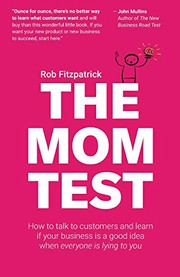
The Mom Test
The central premise: you shouldn't ask people if your business is a good idea. They'll lie to you — not out of malice, but to be polite. So it's your responsibility to discover the truth indirectly, by asking around the subject rather than about it.
The Mom Test (Chapter 2)
Never ask hypothetical questions like "would you ever buy a cooking app?" — too broad, too theoretical. Instead, ask about their actual life:
- What do you usually do on your phone?
- What was the last thing you did on it?
- Did you use an app for that? How did you find it?
People stop digging too early. Keep going. Never mention your app — ask about your customer's life, where they go, how they search, what they've actually done in the past. Future hypotheticals are worthless. Past behaviour is everything.
If someone isn't already searching for a solution, the problem isn't big enough. If they won't talk about money, same conclusion. If they won't make introductions, same again.
Useful questions to have in your back pocket:
- How much does that matter to you?
- What are the implications of that?
- Who else should I talk to?
- Is there anything else I should have asked you?
People want to help — give them an excuse to. The rule: the customer owns the problem, you own the solution. You can't tell them what their problem is; they can't tell you what to build.
Avoiding Bad Data (Chapter 3)
Three things to avoid: compliments, fluff, and feature requests. None of them are real data.
Avoid compliments by not mentioning your idea in the first place. If one slips through, deflect — "sorry, I went into pitch mode there" — and redirect back to their experience. Watch out for soft language like "would you ever", "do you think you might", "could you see yourself" — these can transition a conversation, but don't treat the answers as signals.
If they try to steer back to your pitch, tell them you'll cover it at the end of the meeting, then get back to digging. Keep the grand vision in mind; don't get lost in details.
A lukewarm response means they don't care. Look before you zoom — everyone has problems they know about but don't care enough to fix. Focus on the ones that actually hurt.
Once three customers give you the same answer, move to the next question. Always have three big questions you're trying to answer.
Keep it Casual (Chapter 4)
Early customer meetings might need to be in person — conferences, industry events, meetups. The first conversation isn't really a meeting at all, it's a casual chat. This matters because broad early questions can take five minutes; setting up a formal meeting for that is a bit mad.
A useful three-meeting structure to avoid slipping into sales mode: the problem, the solution, then selling the solution.
Commitment and Advancement (Chapter 5)
Once you've confirmed you might be solving a real problem, you can reveal the idea — and to navigate the compliments that follow, ask for commitment. Real commitment means hesitation. If they give it easily, it doesn't count.
Commitment can take several forms: an introduction to someone closer to a decision, payment now, time with their team on a trial, or agreeing to a public case study. A conversation that turns to compliments is a warning sign — whoever you're speaking to is trying to get rid of you.
At early stage, the real goal is learning. Revenue is a side effect. Look for people who are emotional, who are already trying to solve the problem themselves.
Finding Conversations (Chapter 6)
Either go to them or bring them to you. Impromptu chats can be great for learning but can't really be sales pitches — coming across as deceptive destroys trust fast.
Useful framing when cold: "I'm researching the problems you face in your industry" works better than "I have a product." Immerse yourself where your customers already are.
Other routes in: landing pages (follow up with signups immediately — why did you sign up?), hosting meetups or workshops, blogging with an email footer, asking around for introductions one or two hops away, industry advisors, advisory boards, buying trade magazines, approaching professors who get industry funding.
A solid cold outreach formula: Vision, Framing, Weakness, Pedestal, Ask. Example: "I'm trying to make desk rentals less painful for new businesses (vision, broad). I'm just starting out and don't have anything to sell yet, but I want to make sure I build something that actually helps. I've only ever seen this from the tenant side and I'm struggling to picture it from the landlord's perspective (weakness). You've been doing this for years — you could really help me cut through the fog (pedestal). Do you have 15 minutes in the next couple of weeks? I'm happy to come to you (ask)."
People want to help, but they hate wasting their time. Respect that.
Choosing Your Customers (Chapter 7)
Start-ups don't starve, they drown — too many options, spread too thin. If the problems you're hearing aren't consistent, your customer is still undefined. Getting specific isn't about closing yourself off to new customers; it's about getting focused enough to learn, pivot, and move forward. Once defined, check: are they reachable, profitable, and personally rewarding?
Running the Process (Chapter 8)
Notes need to be relayed objectively. Recording meetings helps. Focus on quotes and on emotions, not just facts. Don't waste people's time — be prepared, know what you want to answer, and don't talk more than they do.
Before speaking to anyone, you should have: a focused customer segment, specific questions that need answering for that segment, and a decision on what commitments you want to ask for. Customer conversations should come after desk research and speaking to an industry expert — or possibly after building an MVP. This stops you wasting time on questions you could have answered without talking to anyone.