Japan earthquake rattles Tokyo region in the early hours
A Japan earthquake with a preliminary magnitude of 5.9 jolts eastern Japan in the small hours of Sunday, 23 August 2026, shaking Tokyo hard enough to wake people, set off phone alerts, and send items tumbling from shelves. Officials report at least 37 injuries across five prefectures, most of them minor, but the incident still lands as a sharp reminder of how quickly normal life in the capital can tilt into chaos. And because it hits while many residents are asleep, the injuries are often the most mundane kind, falls, collisions with furniture, and panicked missteps in the dark.
According to the Japan Meteorological Agency (JMA), the epicentre sits in southern Ibaraki prefecture at a depth of 70 kilometres. The U.S. Geological Survey records the quake at magnitude 5.8, a small difference that is common in early estimates and different measurement approaches. Importantly, authorities say there is no tsunami danger, which immediately changes the risk profile for coastal communities and critical infrastructure.
Even so, the shaking ripples through the everyday systems that keep Greater Tokyo moving. Train services face delays, a water pipe ruptures in the capital, and the government forms a task force to assess potential damage. None of this is catastrophic. But it is disruptive, and it is exactly the kind of stress test that shows whether preparedness measures are actually working in the real world, not just on paper.
What happened, where it hit, and what officials confirm
The injury tally is spread across the Kanto region: 15 injured in Tokyo, nine in Saitama, eight in Kanagawa, four in Chiba, and one in Ibaraki, according to prefectural officials and the Fire and Disaster Management Agency. The pattern matters. It suggests a wide area of noticeable shaking, with the densest concentration of injuries where population density is highest and where people are most likely to be indoors and moving around in confined spaces.
Most injuries are described as light, caused by people falling or striking doors, furniture, or other household items as they react to the quake. One reported case stands out for severity: the Yomiuri newspaper reports an elderly woman in her 80s in Yokohama suffers a serious hip injury after falling from her bed. It is a sobering detail because it underlines a recurring reality of moderate earthquakes in urban settings: the most vulnerable residents often face the greatest health consequences, even when buildings remain intact.
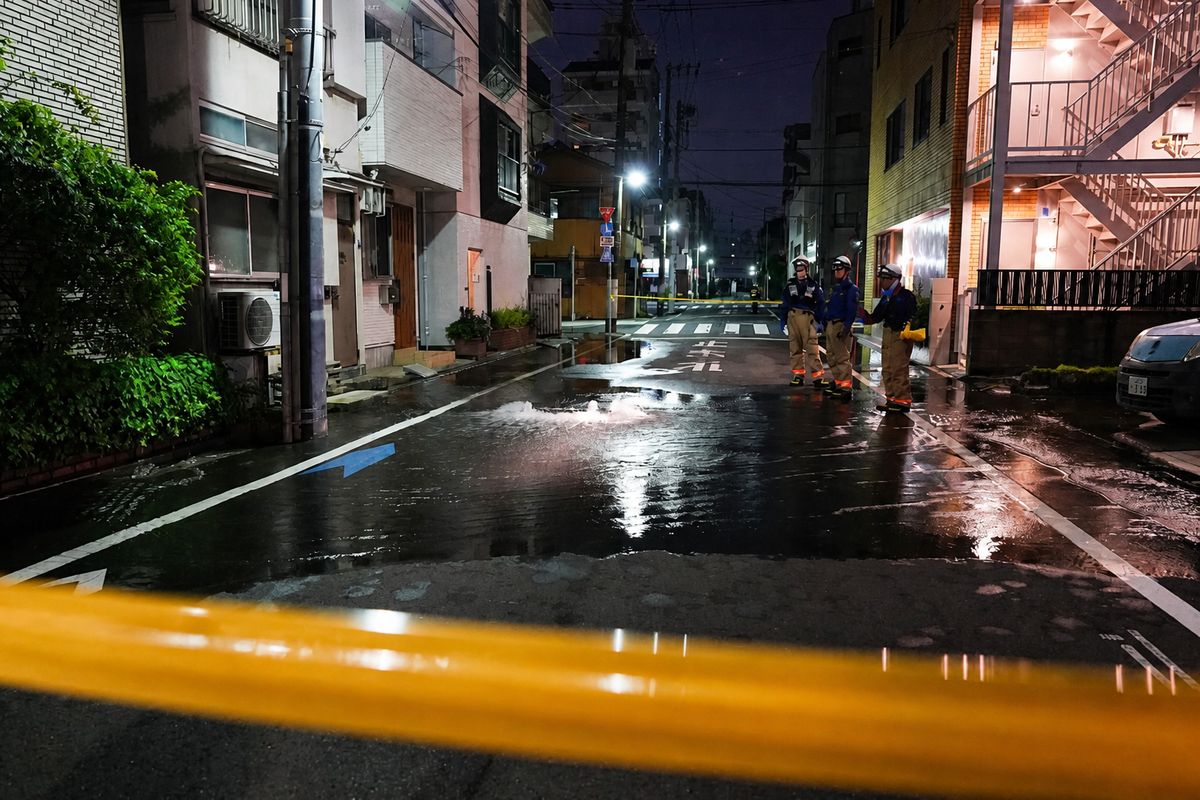
Tokyo’s infrastructure takes a visible hit when an underground water pipe ruptures in Koto ward, sending water onto the road. Footage aired by NHK shows the flooding, and officials later confirm the pipe is repaired and the leak stopped. Meanwhile, NHK also shows road traffic in nearby cities such as Mito and Saitama appearing largely normal, a sign that the disruption is significant but contained.
On the rail network, East Japan Railway Co. says express trains serving Tokyo and Narita Airport, plus other local services in northeastern areas, are delayed. But Shinkansen bullet trains continue running normally. That split is telling: high speed rail is designed with stringent seismic safeguards, while local and express services can be more sensitive to inspections, track conditions, and operational caution after a strong jolt.
How the Tokyo quake feels on the ground, and why injuries happen
One of the clearest snapshots of the moment comes from a 23 year old man quoted by the Asahi newspaper. He describes feeling a vertical jolt seconds after his earthquake alert sounds while he is shopping in Tokyo’s eastern district of Taito. He worries about being struck by merchandise falling from shelves as the building shakes. It is not a dramatic Hollywood scene, just a very normal fear in a very normal shop. But it captures how risk in a city often comes from secondary effects, falling objects, sudden crowd movement, and the simple fact that people do not have time to think.
That timing is crucial. Japan’s emergency alert systems can provide a brief warning, but for a quake close enough to Tokyo to produce strong shaking, the lead time can be seconds, not minutes. In practice, that means many people are still caught off guard, especially at night. They sit up too fast, jump out of bed, rush to doorways, or try to grab phones and torches. And that is when ankles twist, heads bump, and people fall down stairs.
The JMA urges residents to remain cautious about another possible moderate earthquake for about a week. This is not a prediction of a specific aftershock, and the agency does not claim it is. It is a risk management message based on the reality that clusters of seismic activity can follow an initial event. For households, it is a nudge to secure furniture, check emergency supplies, and think through what to do if another jolt arrives at an awkward moment.
And there is a psychological layer too. Tokyo residents live with earthquakes as part of the background noise of life, but each noticeable tremor resets the nerves. People recheck cupboards, rewatch the news, and scroll for updates on transport. The city’s resilience is real, but it is also built on constant low level vigilance, which can be exhausting (fair enough, really).
Japan earthquake preparedness, government response, and nuclear safety checks
In the immediate aftermath, the government sets up a task force to assess possible damage, with Prime Minister Sanae Takaichi announcing the move on X, according to AP. Task forces can sound bureaucratic, but in Japan’s disaster management system they serve a practical purpose: consolidating information from ministries, local governments, emergency services, and infrastructure operators so decisions are coordinated rather than fragmented.
One of the first questions after any significant shaking in Japan is about nuclear facilities. The Nuclear Regulation Authority reports no anomalies at about a dozen nuclear power plants and other facilities that handle nuclear materials. That statement is limited to what is known at the time, and it does not claim there is zero risk. But it is still a key reassurance, particularly because public confidence in nuclear oversight has been shaped by past crises and by the expectation that regulators will communicate quickly and clearly.
Transport operators also move into inspection and recovery mode. Delays on express lines to Narita Airport matter not just for commuters but for international travel, freight, and the broader perception of Tokyo as a smoothly functioning global hub. Meanwhile, the fact that Shinkansen services remain normal is a quiet demonstration of how Japan’s most iconic transport system is engineered and operated with seismic events in mind, including automatic braking and rigorous post quake checks.
The water pipe rupture in Koto ward is another reminder that resilience is not only about skyscrapers. It is about buried networks, ageing pipes, joints, valves, and the ability to isolate and repair a fault quickly. The leak is stopped and the pipe repaired, which suggests response teams are able to move fast. But it also raises the obvious question: how many similar weak points exist under the city, and how would they behave in a stronger quake?
Why this 5.9 quake matters, even without major structural damage
A magnitude 5.9 event is not, by itself, a national catastrophe in a country as seismically active as Japan. But it is still a big deal for three reasons: it injures dozens of people, it disrupts critical urban systems, and it lands in a period when public attention is already heightened by recent seismic tragedy elsewhere in the country.
AP notes that last month a magnitude 7.1 quake strikes the Kumamoto area on the southern island of Kyushu, killing 38 people and injuring 364. That comparison is not about equating the events, they are different magnitudes, different local conditions, different outcomes. But it does shape how the Tokyo region quake is interpreted. After a deadly event, the public and policymakers tend to scrutinise every subsequent tremor more closely, asking whether it is a sign of a broader pattern or simply the normal churn of tectonic life.
There is also the urban density factor. Tokyo and its surrounding prefectures concentrate population, economic activity, and infrastructure in a way few places on Earth do. A moderate quake that causes mostly minor injuries can still produce significant economic friction: delayed trains, disrupted logistics, emergency call volumes, and the knock on effects of people arriving late to work or missing flights. The sources do not provide an economic estimate, and it would be wrong to invent one. But the mechanism is obvious, and it is why even moderate shaking gets treated seriously.
Finally, the event is a live test of public behaviour. Do people take cover? Do they rush outside? Do they know how to shut off gas? The injury descriptions suggest many are still getting hurt in the first seconds of reaction. That is not a moral failing, it is human nature. But it does point to where public education and home safety measures can still reduce harm, especially for older residents.
The Bigger Picture
The Tokyo region quake is a reminder that Japan’s earthquake story is not only about the rare mega disaster. It is also about the steady drumbeat of moderate events that repeatedly probe the weak points of a modern megacity. When a water pipe ruptures in Koto ward, it is not just a local inconvenience. It is a glimpse into how hidden infrastructure behaves under stress, and how quickly a city can either contain a problem or watch it cascade into something larger.
There is a second, often missed angle here: confidence. Tokyo’s resilience depends on public trust that alerts will sound, trains will stop safely, nuclear facilities will be checked, and officials will communicate clearly. The AP report includes several of those reassurance signals: no tsunami danger, Shinkansen running normally, no nuclear anomalies reported, and a government task force established. Each message is small on its own. Together, they form a narrative of competence that helps prevent panic and misinformation from filling the gaps.
And then there is the long view. The JMA’s advice to stay cautious for about a week is not just about aftershocks. It is about keeping preparedness alive in the days after the headlines fade. Moderate quakes can be oddly dangerous in that sense. They do not cause enough damage to force major change, but they do create just enough disruption to show what could happen next time. The challenge for Tokyo, and for Japan more broadly, is to treat events like this as actionable feedback, not background noise.
Historical context: Tokyo’s seismic reality and what changes over time
Japan sits in one of the world’s most seismically active zones, and the Kanto region has long lived with that reality. The sources here do not provide a deep historical timeline, so this article does not attempt to bolt on extra dates or claims. But the basic context is clear from the reporting itself: earthquakes are frequent enough that emergency alerts on mobile phones are a normal part of the experience, and transport operators have established protocols that can keep the Shinkansen running even when other services slow down.
What does change over time is the nature of vulnerability. Modern buildings in Tokyo are designed with seismic standards in mind, and the absence of reported major structural damage in this event is consistent with that broader trajectory. But the injuries described, falls, impacts, panic reactions, show that personal safety inside the home remains a stubborn problem. A city can engineer for building integrity and still see people hurt because a bedside table shifts or a cupboard door swings open at the wrong moment.
Infrastructure also evolves unevenly. High profile systems like bullet trains are built and maintained with seismic performance as a core requirement. Buried water networks, by contrast, can include older segments, complex junctions, and parts that are harder to inspect. The Koto ward rupture is fixed quickly, which is good news. But it also points to the reality that resilience is only as strong as the least glamorous component.
Finally, the comparison with the July 2026 Kumamoto quake (magnitude 7.1, 38 dead, 364 injured, per AP) highlights how outcomes vary dramatically by magnitude, depth, location, and timing. Tokyo’s quake hits at night and injures people in their homes. Kumamoto’s stronger quake produces fatalities and far higher injury counts. The lesson is not that one region is safer than another. It is that preparedness has to be tailored to local conditions, and that even “moderate” events can carry real human cost.
What happens next for Tokyo residents and key services
In the short term, the focus is on monitoring and readiness. The JMA’s guidance to remain cautious for about a week means households and businesses are likely to recheck emergency kits, secure unstable furniture, and pay closer attention to alerts. For local authorities, it means heightened situational awareness, ensuring emergency services are staffed and that information channels remain clear if further shaking occurs.
Transport operators will continue inspections and normalisation. Even when services resume quickly, the operational discipline after a quake matters because it prevents secondary incidents. The same goes for utilities. A repaired pipe is not the end of the story; it is a data point. Where did it fail, why did it fail, and does it indicate similar vulnerabilities elsewhere in the network?
For the national government, the task force announced by Prime Minister Takaichi is a mechanism to gather those answers and coordinate any follow up. The public will also watch for updates on injuries, repairs, and any late reported impacts. In earthquakes, the first reports are rarely the final word, especially when the event happens at 2 a.m. and people only fully assess damage after daylight.
And for the wider world, the Tokyo quake is another reminder that Japan’s capital remains both highly prepared and inherently exposed. The city absorbs shocks better than most places could. But it still gets shaken, literally and figuratively, and the margin between “minor disruption” and “serious emergency” can be thinner than people like to admit.
Reporting in this article is based on information from AP News and Xinhua, including AP’s detailed account of injuries, infrastructure impacts, and official statements.
Read more: AP News report on the Tokyo region earthquake; Xinhua flash update; NHK WORLD-JAPAN coverage; The Japan Times report; Kyodo News report.