
← All Projects

BucketRace

2018 – 2024 active Gross (est.): £312,096 1 unique views 5 total views
BucketRace

Value Add

Highlights, Funny Bits, & Lessons

  • Social proof makes sales
  • The first bite is with the eye
  • You're lucky until you're not
  • Don't put too much on the menu

Read on for the full story.

When I talk about BucketRace, I talk about it in two ways.

Either the parent umbrella company of almost everything I’ve created. Or strictly as scavenger hunts.

For the purpose of this write-up, I will be focused on scavenger hunts mainly.

You can read about the backstory here… The Race

This chapter picks up in 2018.

North, South, East, West

As I mentioned, I’d always felt that itch... what if? In 2018 I decided to find out. Instead of travelling all over Europe, this next scavenger hunt would divide London into North (Camden), South (Brixton), East (Shoreditch), and West (Hyde Park).


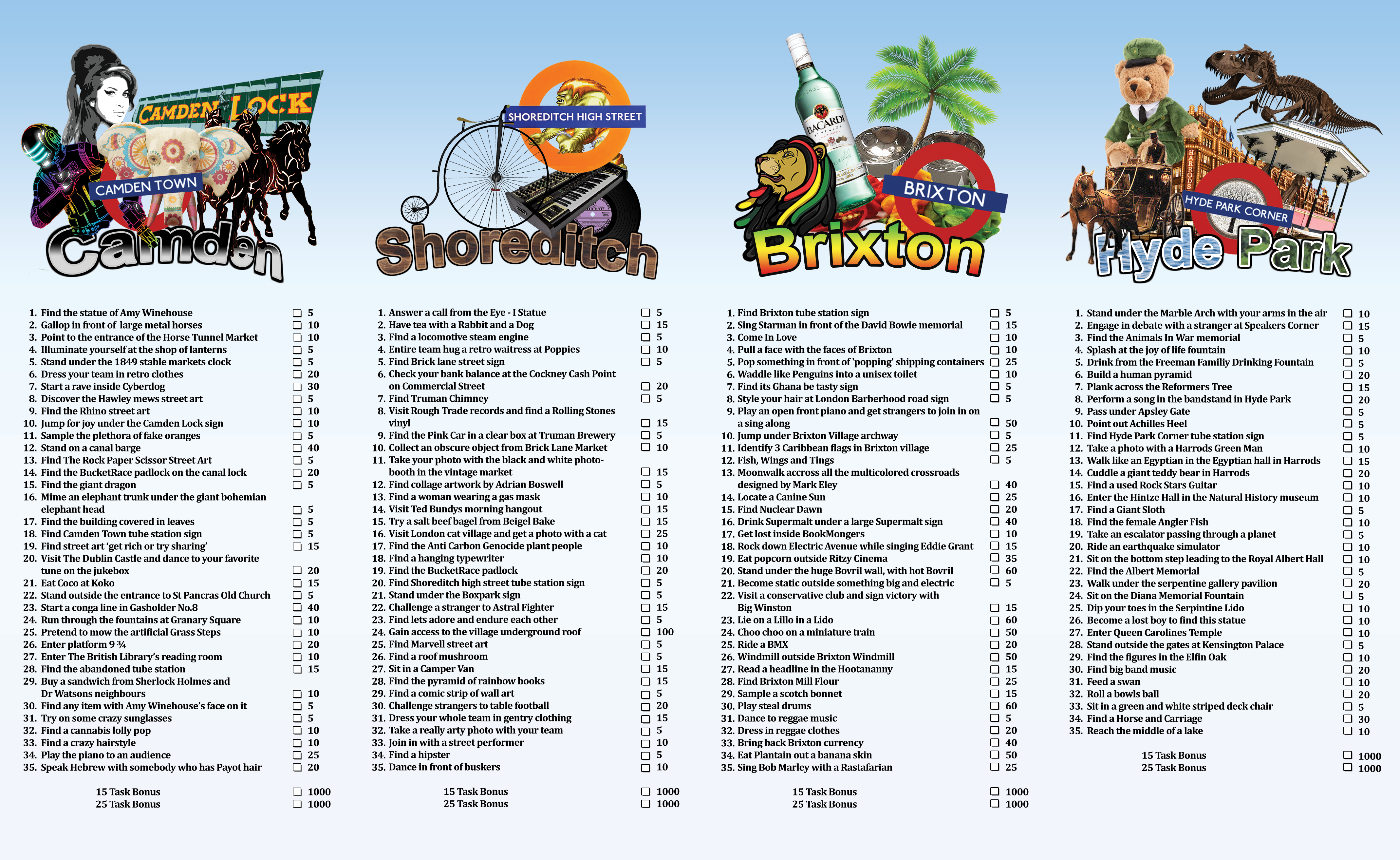
Players could choose a borough and try to complete as many location tasks and challenges as they could, with the chance of unlocking 1,000 bonus points if they reached 15 and 25 tasks. They also received a list of miscellaneous tasks that could be completed anywhere, divided into easy, medium and hard. For example, fit your entire team inside a red telephone box, or crab walk across a zebra crossing.
As proof of concept, I built a website using the most credible, but now very low quality, images from The Race days, and created a load of posters and flyers. I thought the game would appeal to travellers, so I went into every hostel in London (there are over 100), and quite a few hotels, to see if they would help promote and sell the event. I then called around and emailed all the known experience outlets, like Red Letter Day, Groupon, Wowcher, Fever and Design My Night. All of them sounded bamboozled about what I was trying to do, and said no. Except Fever, who got it right away and said yes.

First Even - Four Teams. One Hostel.

I scheduled the first event for April 4th, 2018, and 4 teams signed up, ish… One hostel sent down a team of staff members. ONE lol. My mum, a friend from SAP, and my flatmate formed a team, Fever had 1 sign up, and randomly an enormous Iranian TV channel (Manoto TV) emailed me and asked to enter a team. I did ask the producer how he heard about the event, given it was the first one, and he said he got a little wavy one night, must have found it online and sent an email, but he couldn’t remember.
To play the games, teams needed a Twitter account. They would take a photo or video as evidence that they’d completed a task or challenge, upload to Twitter, and tag @bucketrace with the task name and points value. I would then log it all in a spreadsheet I’d built to work out the points with some automation. I thought everyone tweeting might act as good marketing. It helped a little, but not in a sustainable way.
Anyway, 4 teams playing for 3 hours and taking 30 photos each = a lot more proof of concept. The following week, I updated the website and went back to Red Letter Day, Groupon, Wowcher, and Design My Night. With all the new photos and videos, all of them agreed to sell the experience. For nearly a year, I ran it every weekend that a team signed up. Sometimes there would be 1 team, sometimes there would be 6. No matter, because I would say they can compare their scores to all the previous teams, then go on the website and check the leaderboard I’d built.

At the end of summer, I received an email… Do you do team building events? I said sure. So I went and met with Telenomics to pitch the idea. I was quite nervous, because it was literally me and a spreadsheet, but I realised they didn’t care about that at all. They just wanted to do something fun. I even upsold a custom video that I edited in 20 minutes at the end of the event! Mad.

Spreadsheets, 100 Players, and Brown Trousers

The first team building event was held on 7th August 2018 and went really well. I started getting more TripAdvisor reviews from the weekends, and more enquiries came through the door.

On the 16th of November 2018, I ran an event of over 100 players with Grant Thornton. This event stands out for a few reasons.

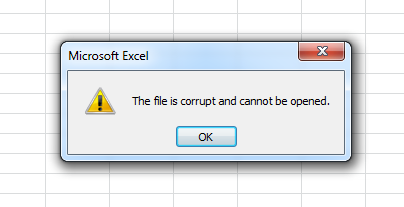
  1. My spreadsheet became corrupted during the event, meaning I had to rebuild and manually redo the points of 14 teams in the space of 30 minutes. Needless to say, that was brown trousers time.
  2. It was my first event of that size, and I ran it solo.
  3. I received some of the most helpful feedback of my career.
After the event I emailed asking for Grant Thornton to be a case study for the website, and they agreed to give a glowing review. However, I also received a private piece of feedback from someone quite senior in the company.


Overall Experience: The scavenger hunt was well received, with the Director noting that all feedback came across as very positive and calling it “a great afternoon”.

Facilitation & Engagement: The Director observed that facilitation was minimal (consisting mainly of a brief introduction, handing out materials, and announcing prize winners). They noted that previous treasure hunts had larger teams who interacted with participants throughout the event.

Cost & Outlay: Based on the limited team presence during the activity, the Director raised a question regarding the cost relative to the visible outlay by organisers.

People Pay for Vibes

At this point I was charging £15 a head, way below the market price. But even at that price point, the feedback noted lack of presence, and this has become a lifelong lesson.

I could put 200 hours of work into something, build an app, create the graphics, the music, etc… But most people don’t care at all. They can’t imagine the craft, the years of training, the difficulty. They pay for what they see, how they feel, and what they understand. People buy iPhones, but they have no idea of the years of science and engineering that have gone into hijacking the electromagnetic spectrum, to send packets of data via waves that bounce off satellites launched into space. They care if Candy Crush doesn’t load quickly enough.

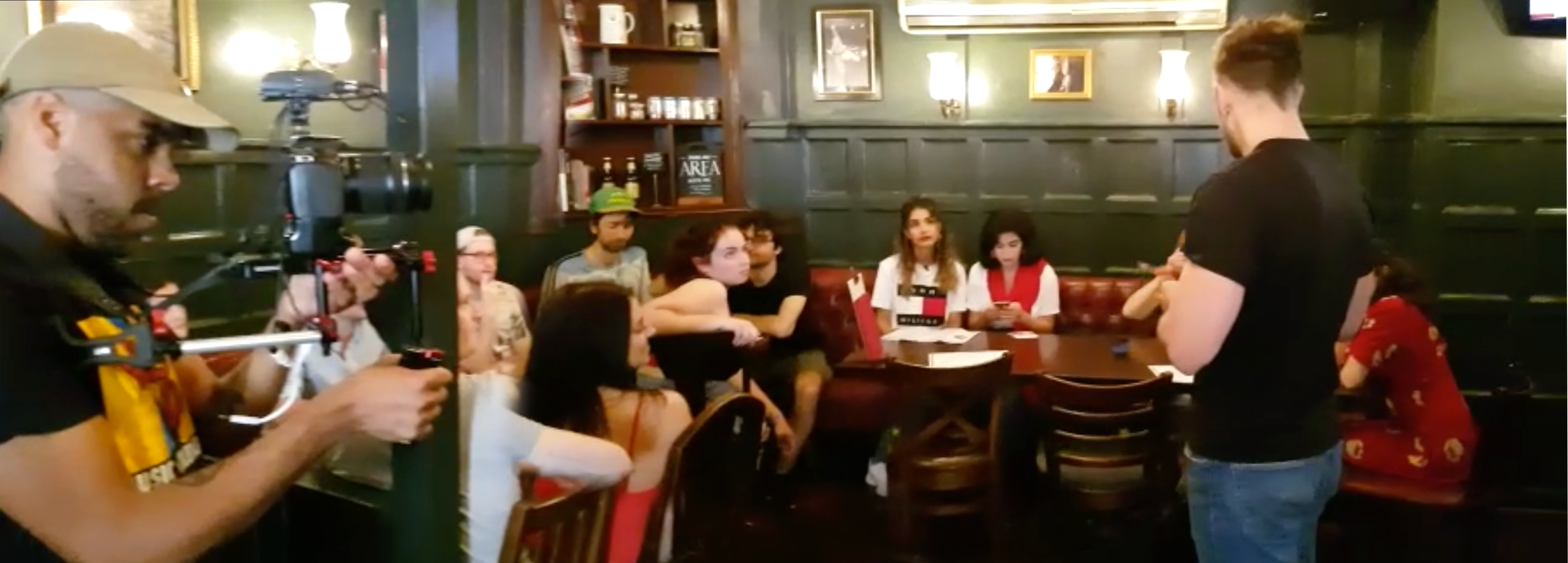
I knew exactly what they meant, so from that day, I had some custom tops made up, introduced trophies, and for larger events, I bring event staff. It’s completely unnecessary from a practical standpoint, BUT, the vibes check out, and people pay for vibes. That psychosocial perspective has allowed me to more than double my price, and I haven’t had someone query it once since, so… To whoever that director at Grant Thornton was, thank you.

17 Routes

I moved away from North, South, East and West, because a few things became clear to me. Companies often wanted to start near their office, and the routes didn't cater for that. At this point i'd already started building more routes for game like Grant Thornton, and it became clear to me that there were quite nice divisions between different parts of London. I spent the next year carving everything up, and ended up with 16 routes. All routes except Greenwich (which in my opinion is one of the best) have been played!

Prizes

Team building was picking up, but I was far more interested in the public games. One incentive I experimented with to attract more players was offering prizes. Aaaaaand, the whole idea of BucketRace came from crossing things off a Bucket List, so this felt honourable to me.


Rather than offering traditional prizes, I introduced experience-based rewards: Ice Wall Climbing (Summer Season), Chocolate Making (Easter Hunt), Scale the O2 (Summer Season), Paternoster Chop House (Valentine's Hunt), and Fright Night (Halloween – although they never sent me any photos!).


Even after paying for all these experiences, I was still in the green. That is, apart from one occasion when a team returned a full 30 minutes after the event had ended! Every other team had gone home, and I was already packing up.

By this point, teams were losing 100 points for every five minutes they were late. This particular team had sacrificed 600 points in late penalties, only to earn 1,000 bonus points for completing the game. Meaning... they'd actually won. Looooool.


Now, in the interest of fair play, I couldn't exactly take away the prize from the team I'd announced as the winners 20 minutes earlier. So, I did the only thing I could think of: I gave out two prizes!


On this day the rules changed. 150 points for every 5 minutes, and more than 15 minutes late... You loose all your points. So don't be late.

Pigeon Race

Things were fairly quiet from January through April, but as spring rolled around, business started picking up again. I began to understand the seasonality of different industries and how demand fluctuated throughout the year.


For the Easter event, I decided to take a more proactive approach to promotion. I started reaching out to PR agencies and news outlets, hoping to generate some interest and get people to attend.


Then I had what I thought was a brilliant idea. What if, instead of simply clicking a link to RSVP, people had to complete a little game first?


So I created something called Pigeon Race. The concept was simple: you'd control a little pigeon flying across the screen, collecting tokens along the way. Once you'd collected enough, you'd jump through a portal that would take you directly to the RSVP page on the website, where you could sign up for the event.


In my head, I was thinking, "The editor of Time Out is definitely going to play this. He's going to see my Pigeon Race game and think, 'Wow, this guy is a creative genius. I have to go to his event.'"


I genuinely thought I'd come up with something incredible.


Anyway, no one played it. lol.


Then from May 2019 to December 2020, the business grew 300%, but I started to notice an issue.

I didn’t have a product that made running the event for smaller groups worthwhile. A group of 4 paying £30 was too much work for the return, and was a harder sell. So I designed a product that was more expensive but more intimate: a Theatrical Scavenger Hunt, with an in-character host. I invested most of the previous year’s revenue into developing the game, and we ran the first one on 27th February 2020.


Theatrical Scavenger Hunts, with a Character Host

In traditional style, I went all in. I'd created 16 routes at this point, so I decided I needed 17 characters.

  1. Bonus Character: The Green Lion
  2. Waterloo: ABBA Skatespear
  3. Regents Park: Hercule Holmes
  4. Stratford: Daley Redgrave-Wiggins
  5. Shoreditch: Johnny Synth
  6. Portobello Market: Paddington Thacker
  7. Square Mile: Panooplyai Ananas the 3rd
  8. Soho: Connie Lingus / Richard Cummings
  9. Central London: Avery and Mavery Jett Von Setter
  10. Covent Garden: Dr Houdini Michaels (Magic Mike)
  11. Camden: Iggy Osbourne (Jonathon Pumpernickel)
  12. Brixton: Marley (Golden Haze) Jahman
  13. Greenwich: Copernicus Hubble
  14. Hyde Park: Zordon Grylls
  15. London Bridge: Lancelot Boleyn
  16. Westminster: Corgi Arthur Butler
  17. Docklands: Walter Buffet
  18. East End: Frankie Beggar (not pictured)

The Green Lion

One Friday afternoon, mid-BucketRace era, a 'fixer' called asking if I could do a Children's Birthday Party in Hyde Park at short notice. I'd never done one, so I improvised a character on the spot — The Green Lion. What followed is one of the most amusing things I've ever been part of, and it deserves its own page.

Read The Green Lion →


The Pandemic

Having invested my capital back into the business theatrical pivot, I entered the pandemic with minimal cash reserves and fell straight through the cracks of UK government support. Because I was a limited company director who hadn’t taken a PAYE salary, I couldn’t claim furlough, and my corporate structure disqualified me from self-employed grants. They needed more than a year of tax returns.

Along with hundreds of thousands of other small directors, I was left out because HMRC couldn’t verify dividend income in real time, and HM Treasury refused to create a tailored scheme out of fear of fraud.

Great… Now what? I had zero income.

You can read what I did right away here: LIFT Clinic

As for BucketRace, I literally thought it was kaput. But I did have one lever to pull. Over the past year, I’d started building quite a large team building supplier network. Most of them were much more established and furloughed themselves. However, one new supplier called Avva Experience, who’d taken investment and found themselves in the same position as me, stayed in touch on the phone. We kept asking each other: what are you seeing? What are your plans?

As far as I can tell, between March and August, most businesses were riding things out, hoping things would calm down. In August the phone started to ring from previous clients… have you got anything we can do via Zoom? I said sure, and started running virtual scavenger hunts. BUT, they were so stressful without the right technology. My laptop was getting old, spreadsheets weren’t quick enough, Twitter didn’t make sense, and the whole thing felt clunky and disorganised. I needed to do something else.

I received another call from Avva, saying they were getting a lot of enquiries for quizzes, to which I replied, I’ve got something better…

This part of the story continues at Fat Big Quiz

Post Pandemic

Most of my contractors went back to their previous lives as session musicians; however, I kept on two full-time employees. Financially, even after some poor spending decisions, we were in pretty good shape.

The following year was very busy. A lot of people did not want the hassle of covid passports, and lots of people did not want to get the jab, which meant a lot of domestic team building, stag dos and hen dos, and we were still doing loads of virtual events, as a habit hangover from the pandemic. Things were getting much easier because of my redeveloped proficiency in programming, and for a while it was hard to complain. We developed routes for Bristol, Manchester, Liverpool, Leeds, Brighton, Dublin, Paris and Newcastle, and ran a few events around the country.

However, as covid passports waned, the war in Ukraine kicked on, and people started to realise that inflation wasn’t coming down, the business dried up.

The website had also become completely polluted with all these different events. There’s a Kitchen Nightmares principle that always sticks in my mind… there’s too much on the menu. Customers get decision paralysis. The name of the game is to do one thing really well, in a big enough market.

By the end of the pandemic, navigating the website was like playing chess. I’d been publishing blogs on quizzes that were gaining hundreds of thousands of visits a year, so most people thought BucketRace was a quiz company. There was no coherent sales and marketing funnel. The brochures were cool but convoluted, geared towards a corporate events brand, but the company name sounds like scavenger hunts, not corporate events. The whole thing lacked market fit, and I think that hurt sales. If I could do it over, I would have created separate sites during the pandemic for each product. But hindsight is 20/20. I didn’t know I’d end up with so many different offerings, I didn’t know how busy I would be, I didn’t know how under pressure I would be, and I get why I did what I did.

Figuring Out What’s Real

This baptism of fire made me obsessed with understanding what on earth is going on, in general I mean. How does this all work? Markets, money, business, investment. I’d always had to create out of necessity, and I’d been lucky enough to have some success, but I didn’t really know how anything worked. What was real and what was hype, fake, or smoke and mirrors.

My spending during the pandemic really opened my eyes. Chucking money at a situation does very little without the correct strategy, and even then you need a lot of luck on your side. To put it briefly, I became pretty obsessed (and still am) with figuring fact from fiction. What’s luck and what is within our control?

I started to understand that economically, things did not look good, and the first thing to get cut from budgets is almost certainly going to be scavenger hunts haha. I’d actually been riding a pretty serendipitous gravy train. Pre-pandemic, people weren’t afraid to spend, and there were loads of start-ups and small businesses flush with investor money, going on team bonding. During the pandemic, there was a lot of money printing that found its way into people’s savings accounts and company balance sheets, and post-pandemic there was an afterglow. But when things start to get tough, companies stop hiring, then they stop spending, HR gets cut early, then they start firing. A business at its core needs product, sales and finance. In times of crisis, most other roles are vulnerable.

I had to let my two employees go. I decided that while I figured things out, I’d briefly go back to working in tech sales, but the week I joined, the person who hired me was fired, a new CEO was appointed, the CFO left, the Finance Director left, and the whole company basically fell apart, so I jumped ship pretty quickly.

Fast forward to today. BucketRace still runs, but it’s mainly passive. If public events get busy, I run them. If team building enquiries come in, I do them. However, I don’t actively market, and do very little laptop work anymore. I automated all the systems, built an app, and every now and then I do a phone call. This isn’t to say I won’t pick it up again. It has a strong history, hundreds of 5-star reviews, and good trust, but unless I can find a bigger market, or a better business model, for now it stays where it is.

Technologies

google sheets twitter app script

Lessons Learned

Lessons Social proof makes sales→ A Good Example Is The Best Sermon The first bite is with the eye→ People Fooled By Scale You're lucky until you're not→ Know The Rules Of The Game Don't put too much on the menu→ Paradox Of Choice