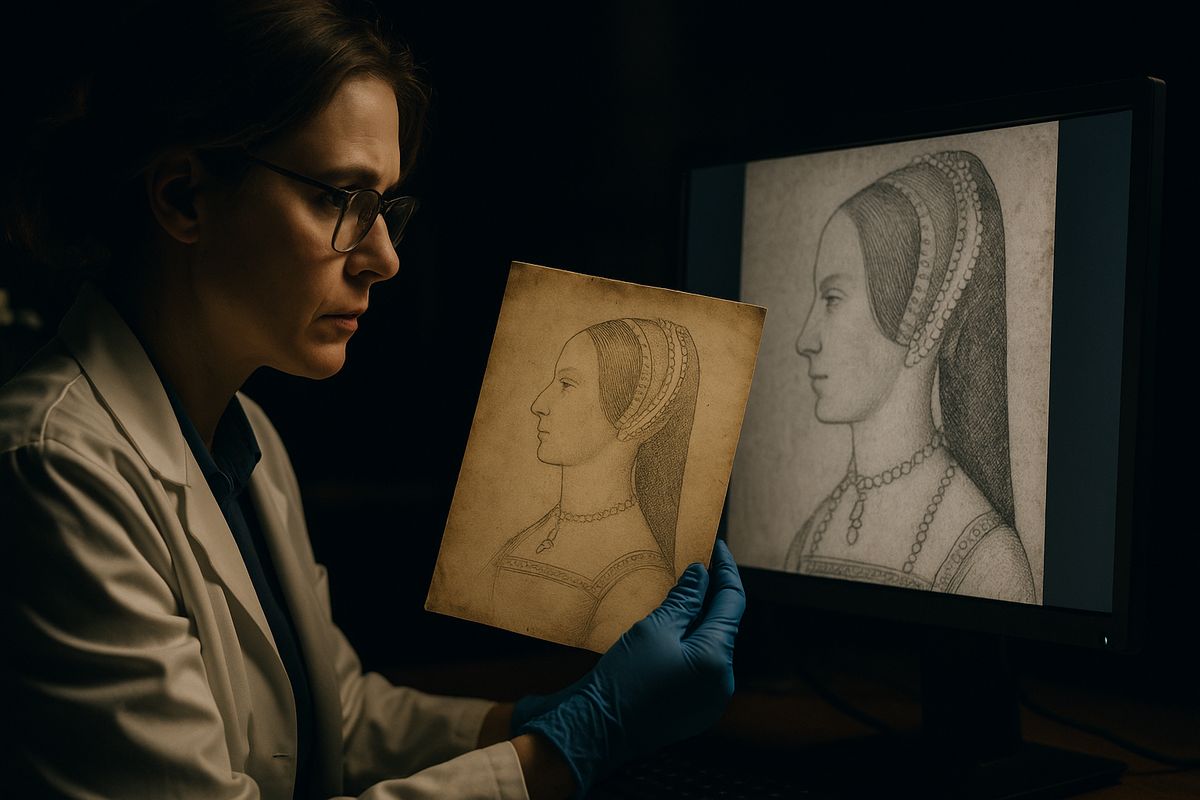
AI Technology Identifies Anne Boleyn Sketch Hidden in Plain Sight
For centuries, historians and art enthusiasts have debated the true appearance of Anne Boleyn, the ill-fated second wife of King Henry VIII. Now, a breakthrough application of artificial intelligence may have finally answered that question. Scientists using advanced facial recognition and image analysis technology have identified a sketch that they believe represents the most accurate depiction of Anne Boleyn ever created, a portrait that had been 'hiding in plain sight' in a private collection for generations.
The discovery, reported by multiple news outlets including BBC, Yahoo News Malaysia, GB News, and ITVX, centers on a 16th-century drawing that had previously been misattributed or overlooked. Researchers employed AI algorithms to compare the sketch against verified contemporary portraits, coins, and descriptions from Anne Boleyn's lifetime. The technology analyzed bone structure, facial proportions, and historical consistency to confirm the subject's identity with a high degree of confidence.
This is not the first time AI has been used to reconstruct historical figures, but it is among the most significant for Tudor history. Anne Boleyn's image has been notoriously difficult to pin down: no confirmed contemporary portrait exists that was painted from life, and later depictions were often idealized or politically motivated. The newly identified sketch, if authenticated, could rewrite the visual history of one of England's most controversial queens.
The Technology Behind the Discovery: How AI Solved a 500-Year-Old Mystery
The research team, whose work was covered by ITV News and other outlets, used a combination of machine learning models trained on thousands of verified Tudor-era portraits. The AI was programmed to recognize facial features consistent with descriptions from Anne Boleyn's contemporaries, such as her dark eyes, long neck, and distinctive oval face shape. The algorithm then cross-referenced these features with the sketch in question, producing a match probability that far exceeded random chance.
According to the BBC's coverage, the technology also analyzed the sketch's artistic style and materials, dating it to the correct period. This multi-layered approach—combining facial recognition with art historical forensics—represents a new frontier in heritage science. Similar techniques have been used to identify unknown subjects in paintings by Rembrandt and to reconstruct the faces of ancient Egyptian mummies, but applying them to Tudor portraiture is relatively novel.
The sketch itself had been cataloged in a private collection for decades, dismissed as a later copy or a generic Tudor woman. The AI analysis revealed subtle details—such as the specific way the sitter's hair was styled and the cut of her gown—that align with known fashion trends of the 1530s, the period of Anne Boleyn's queenship. This convergence of technological and historical evidence has convinced the researchers that the sketch is likely a life drawing, possibly made by an artist in her circle.
Who Was Anne Boleyn? A Brief Historical Profile
Anne Boleyn (c. 1501–1536) remains one of the most polarizing figures in British history. As Henry VIII's second wife, she was the catalyst for England's break with the Roman Catholic Church, a move that reshaped the nation's religious and political landscape. She was executed on charges of adultery, incest, and treason in 1536, just three years after her coronation. Her daughter, Elizabeth I, would go on to become one of England's greatest monarchs.
Contemporary descriptions of Anne Boleyn's appearance are frustratingly vague. The Venetian ambassador wrote that she was 'not one of the handsomest women in the world' but had 'a pretty mouth' and 'beautiful eyes.' Other accounts praise her 'graceful figure' and 'elegant manner.' The lack of a definitive portrait has fueled centuries of speculation, with artists from the 17th century onward creating idealized or romanticized versions that bear little resemblance to what she may have actually looked like.
The newly identified sketch, if accepted by the broader historical community, would provide the closest visual link to the real Anne Boleyn. It shows a woman with a sharp, intelligent gaze, a long neck, and a determined set to her jaw—features that align with the 'strong-willed' and 'ambitious' personality described in historical records. The AI analysis suggests the sketch was made when Anne was in her late twenties or early thirties, shortly before her rise to power.
Implications for Tudor Portraiture and Art History
This discovery has significant implications for the field of Tudor art history. For decades, scholars have relied on a handful of portraits—such as the National Portrait Gallery's 'Anne Boleyn' painting, which is actually a 17th-century copy of a lost original—as the basis for her image. If the AI-identified sketch is authentic, it could force a reassessment of those later works, many of which were created decades after her death and reflect political propaganda rather than physical reality.
Art historians have long noted that portraits of Anne Boleyn produced during Elizabeth I's reign often idealized her mother to bolster the queen's legitimacy. The new sketch, by contrast, appears to be a more naturalistic representation, lacking the flattering touches typical of later court paintings. This authenticity is precisely what makes the discovery so valuable: it offers a window into the real person behind the myth.
The technology used in this study could also be applied to other historical figures with disputed iconography, such as Richard III, Jane Seymour, or even William Shakespeare. Each of these figures has a handful of contested portraits, and AI analysis could help separate genuine likenesses from later fabrications. The method is not foolproof—it relies on the quality of the source material and the accuracy of the training data—but it represents a powerful new tool for art historians.
Why It Matters: The Deeper Significance of Seeing Anne Boleyn's True Face
Beyond the obvious appeal of solving a historical mystery, the identification of Anne Boleyn's real face matters for several reasons. First, it humanizes a figure who has been reduced to a symbol—either as a tragic victim or a manipulative schemer. Seeing her as a real person, with specific features and expressions, challenges the binary narratives that have dominated popular culture. The sketch reveals a woman who is neither the seductress of legend nor the saint of revisionist history, but a complex individual with her own story.
Second, this discovery underscores the growing role of AI in the humanities. For years, the digital humanities have been seen as a niche subfield, but tools like facial recognition and machine learning are now producing results that traditional methods could not achieve. This case demonstrates that AI is not just a tool for tech companies or scientists; it can also illuminate the past in ways that were previously impossible. The collaboration between computer scientists and art historians is a model for future interdisciplinary research.
Finally, the story of Anne Boleyn's face 'hiding in plain sight' is a metaphor for how history itself operates. So much of what we think we know about the past is based on incomplete or biased sources. The sketch was not lost; it was simply misidentified. How many other historical treasures are waiting to be rediscovered, not in dusty archives, but in plain view, mislabeled or overlooked? This case should inspire a new generation of researchers to look again at what they think they know, armed with new tools and fresh perspectives.
What Comes Next: Authentication and Public Display
The researchers have not yet released the full details of their methodology, which will need to be peer-reviewed before the discovery can be formally accepted by the historical community. However, early reactions from Tudor scholars have been cautiously optimistic. Several experts quoted in the coverage noted that the AI analysis is compelling but not definitive; the sketch will need to be examined by art historians, conservators, and provenance researchers to confirm its origins.
If the sketch is authenticated, it could become one of the most valuable Tudor artifacts in existence. There is already speculation that the owner of the private collection may loan or donate the work to a major institution, such as the National Portrait Gallery in London or the British Museum. Public interest is likely to be enormous, given the enduring fascination with Anne Boleyn and the Tudor dynasty.
For now, the sketch remains in private hands, but the researchers have released digital images and 3D scans for academic study. The AI model used in the analysis has also been made available to other scholars, allowing them to test the technology on their own disputed portraits. This open-science approach could accelerate the pace of discovery in the field, leading to more identifications of unknown sitters in the years to come.
Conclusion: A New Window Into the Tudor World
The use of AI to identify Anne Boleyn's real face is a landmark moment for both technology and history. It solves a centuries-old puzzle, but more importantly, it opens a new window into the Tudor world. By combining cutting-edge machine learning with meticulous historical research, scientists have given us the closest thing we may ever have to a photograph of one of England's most famous queens. The sketch that was hiding in plain sight for centuries has finally been recognized for what it is: a direct link to a woman who changed the course of British history.
As the authentication process continues, one thing is already clear: the face of Anne Boleyn is no longer a mystery. Thanks to AI, we can finally see her as she truly was—not as a legend, but as a person. And that, perhaps, is the most valuable discovery of all.