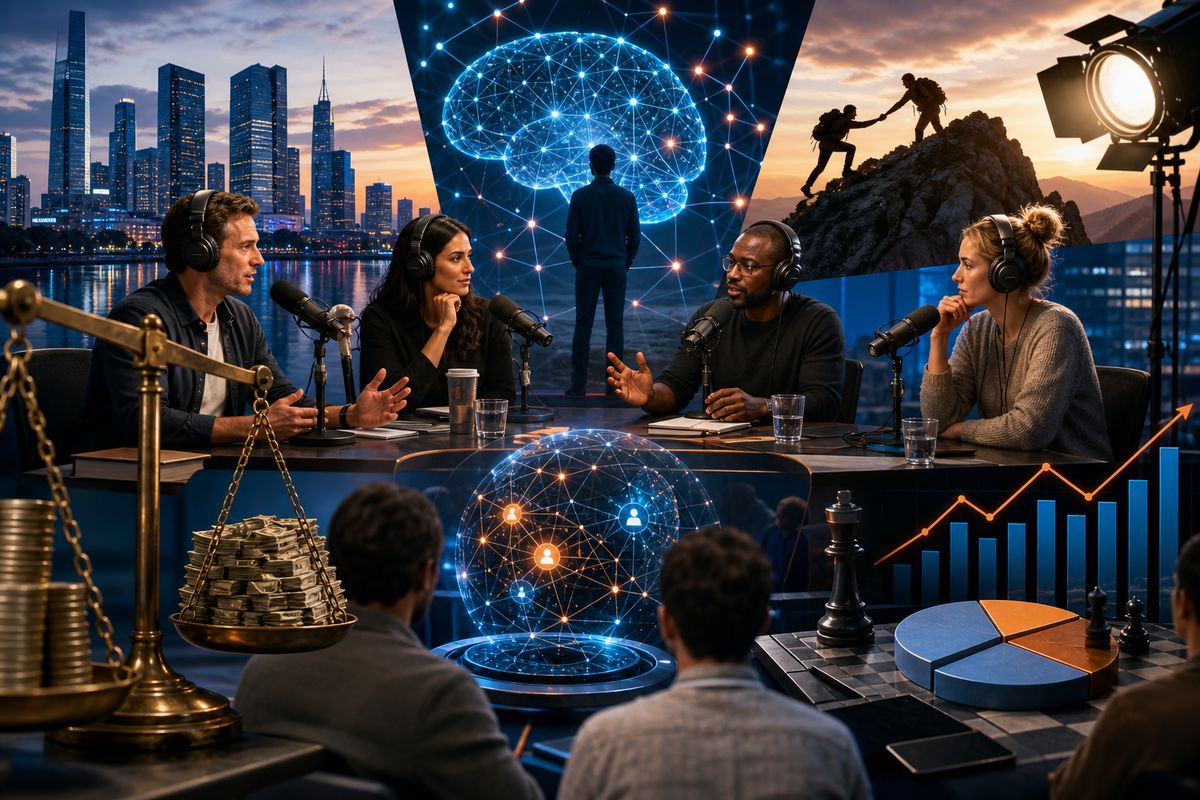
Founder podcasts in 2026 are becoming a serious business tool, not just inspiration
Founder podcasts in 2026 sit in an interesting place. They are still, obviously, entertainment. But they increasingly function like a lightweight executive education layer for people who do not have time, money, or frankly patience for formal programmes. And the shift is visible in the way three shows position their value: Focus on Founders hosted by Matthew Adams, The Diary Of A CEO with Steven Bartlett, and the Practical Founders Podcast hosted by Greg.
What is new in the current cycle is not the existence of founder interviews, that is old hat. It is the way the content is splitting into three distinct lanes: emotionally raw founder stories that foreground mental health and identity, culture scale narratives that treat community as a product, and highly operational conversations about distribution, pricing, AI adoption, and exits. Put simply, the genre is maturing. And that matters because these shows are now shaping how early stage and growth stage operators talk about capital, risk, and what success is supposed to feel like.
The latest material across the three feeds makes the point. Focus on Founders runs an episode dated 22 April 2026 with Duncan Di Biase of Brillband, framed around burnout, raising £670k pre revenue, and selling the business. The Diary Of A CEO publishes a long form conversation with tech critic Ed Zitron titled “The Man Who Calls BS On AI: AI Is The World’s Greatest SCAM, And They All Know It!”, a two hour and 27 minute episode that leans into the idea of an AI bubble and the economics of data centres. Meanwhile, Practical Founders continues to build an archive of operator level lessons, including its own headline about what “Active SaaS Buyers Want in 2026” and a stated dataset of 155 founders interviewed, $12.5B in total founder equity value, and $79M average founder equity value, with zero VC funded founders featured.
These are not small editorial choices. They are signals about what founders are anxious about, what they are proud of, and what they want to learn next.
Focus on Founders spotlights the hidden cost of building, and the uncomfortable maths of £670k raised pre revenue
The clearest “news” development in the source material is the way Focus on Founders frames its latest episodes as founder reality, not founder mythology. The 22 April 2026 episode with Duncan Di Biase is explicit about the emotional and financial contradictions that sit behind a neat startup narrative. Di Biase builds Brillband, described as a Glasgow based broadband provider built around fairness and transparency, after burning out running his first business and being diagnosed with anxiety and depression as lockdown hits. The trigger is almost absurdly specific, a broken therapy session interrupted by the broadband provider that has been overcharging him for months. And that is the point. The origin story is not a pitch deck. It is a bad day that turns into a decision.
Two details land hard for anyone who has ever tried to finance a company. First, Di Biase raises £670k pre revenue. The show positions that as an achievement, but also as a prompt to interrogate what that money is for, what it costs in control and expectations, and what happens when the business does not exit in the way outsiders assume. Second, the episode description states he sells the business he poured everything into and walks away with nothing. No extra context is provided in the source material about deal structure, liquidation preferences, or timing, so it would be wrong to speculate. But the editorial decision to include “walking away with nothing” in the headline is telling. It aims straight at the myth that fundraising equals personal wealth.
The show’s other April 2026 episode, “The Business of Belonging: Jared Keir on Building Fellow Humans Across 20+ Cities”, pushes a different but related theme. Fellow Humans is presented as a global community movement designed to tackle modern loneliness through real world events, scaled across more than 20 cities. The episode description calls out “community as a scalable business model” and “why belonging is becoming the next major industry”. That is not fluffy language. It is a claim that connection can be productised, operationalised, and expanded across geographies, with all the execution headaches that implies.
And then there is the 17 March 2026 episode with Joshua Adams, focused on starting a tutoring business at 17 while still in school. It is a smaller story in market terms, but it rounds out the editorial stance: entrepreneurship is not only venture backed tech. It is services, education, and local trust building. In other words, founder podcasts in 2026 are widening the definition of a founder, and that changes who listens and what they expect to hear.
The Diary Of A CEO turns AI scepticism into mainstream founder conversation
Steven Bartlett’s The Diary Of A CEO operates at a different scale and with a different kind of cultural gravity. The source material positions Bartlett as a British entrepreneur, investor, and author, and as founder of Flight Story, a media company, and Flight Fund, an investment fund backing “category defining” businesses. That matters because it frames the show as adjacent to capital, not just commentary. When a platform like that runs a headline claiming “AI Is The World’s Greatest SCAM”, it is not a niche debate. It becomes dinner table talk in startup circles.
The Ed Zitron episode, published “Today” in the source feed, is structured as a sweeping critique of the generative AI boom. The description states that Zitron believes generative AI is a “con”, argues that OpenAI and Anthropic are burning billions and cannot turn a profit, and warns of a “$500 billion debt bomb” tied to data centres. Those are strong claims, and the source material does not provide underlying evidence or datasets, so the responsible approach is to treat them as Zitron’s stated position rather than settled fact. Still, the editorial impact is real: it legitimises scepticism as something founders can say out loud without sounding like they “do not get it”.
There is also a practical thread running through the episode outline: how tokens work, the actual cost of AI, the power demands of data centres, and whether people would use AI if they paid the honest cost. This is not just ideology. It is unit economics, infrastructure, and adoption friction. And it intersects directly with what many operators are living through in 2026: AI features are expected by customers, but the cost base can be brutal, and the differentiation is often thin.
In the same feed, another episode teaser references research on the “parental brain”, including a claim that parenthood shrinks the brain and drops testosterone 25% for fathers. The source material is truncated, so it is not possible to verify the study context, sample size, or methodology from what is provided. But the inclusion is still relevant to the founder media story: these shows are blending business with biology, psychology, and identity. The founder is not just a revenue machine. The founder is a human body under stress, sleep deprivation, and social pressure. Fair enough, that is closer to reality.
Practical Founders Podcast makes the anti VC stance measurable, and ties “what buyers want in 2026” to execution
If The Diary Of A CEO is the big stage and Focus on Founders is the intimate confessional, the Practical Founders Podcast is the operator’s notebook. The show’s positioning is unusually explicit: every week, Greg interviews a successful software founder who started, grew, and often sold a valuable B2B SaaS or AI software company without big VC funding. Then it backs that positioning with numbers: 155 founders interviewed, $12.5B total founder equity value, $79M average founder equity value, and zero VC funded founders. Those figures are presented as show level statistics in the source material, and they function as a credibility engine. They say, “This is not theory. This is a pattern.”
Several episode headlines in the provided list point to the show’s core editorial thesis: distribution and domain knowledge beat shiny features. Episode #210 is titled “4th Time Founder: Solve Distribution First, Write Code After”, featuring Vic Levitin, described as a serial founder who built companies in Israel for two decades before fleeing the war with his young family to Koh Samui, Thailand. Even without the full transcript, the headline alone is a direct challenge to the default builder instinct. It suggests that product development is downstream of go to market clarity, not the other way round.
Episode #208, “How AI Rewrote What Active SaaS Buyers Want in 2026”, is the most time specific signal in the entire source pack. It frames 2026 as a year where buyer expectations have shifted, presumably because AI is now table stakes in many categories. The guest is Mike Lyon, founder and managing director of Vista Point Advisors, a boutique sell side investment bank he started almost sixteen years ago, and a former chemical engineer at Exxon and BP who later joined Citigroup. That background matters because it implies a finance and M&A lens on what buyers value, not just a product lens.
Other headlines reinforce the same practical orientation: “The Biggest Pricing Mistakes That Hurt Growing SaaS Companies”, “Domain Knowledge Is the New Moat, Not Features and Code”, and “Every Software Team Should Put AI Agents on the Org Chart”. The show is essentially mapping a playbook for building durable, sellable software businesses in a market where capital is more selective and AI has changed the baseline.
What founder podcasts in 2026 reveal about capital, exits, and the new honesty around outcomes
Put the three shows side by side and a clear narrative emerges: founders are renegotiating their relationship with capital. In Focus on Founders, Duncan Di Biase raises £670k pre revenue, then sells and reportedly walks away with nothing. In Practical Founders, the brand promise is “without big VC funding”, and it is treated as a feature, not a limitation. In The Diary Of A CEO, the AI conversation is framed around companies “burning billions” and the possibility of a crash that could wipe out the economy, again, a guest claim rather than a proven forecast, but still a powerful framing.
The connective tissue is a growing discomfort with the old script: raise, grow at all costs, exit, win. Founder podcasts in 2026 increasingly highlight that the script can end in exhaustion, loss of control, or financial outcomes that look nothing like the headline valuation. And because these are audio conversations, not investor memos, they can say the quiet part out loud. That is a big deal for first time founders who have only ever seen the glossy version on social media.
There is also a more subtle shift: founders are not only asking “How do I grow?” They are asking “What am I trading away?” The Di Biase episode description explicitly includes mental health, resilience, and investment mistakes. The Jared Keir episode frames loneliness as a market and belonging as an industry, which is both hopeful and slightly unsettling. The Practical Founders positioning implies that keeping equity and building profitably is not just morally satisfying, it is economically rational.
Historically, founder media has oscillated between hero worship and hustle culture. What is different now is the normalisation of constraint. Constraint in energy, constraint in capital, constraint in attention. And that is arguably a healthier foundation for the next wave of businesses, especially outside the traditional venture hubs.
AI, distribution, and community are converging, and operators need a sharper playbook
The AI thread runs through all three sources, even when it is not the headline. The Diary Of A CEO makes it explicit through Ed Zitron’s critique of generative AI economics and data centre power demands. Practical Founders makes it operational through the idea that AI has rewritten what active SaaS buyers want in 2026, and through the suggestion that software teams should put AI agents on the org chart. Focus on Founders does not foreground AI in the provided episode descriptions, but it does foreground the human cost of building in a world where speed and always on expectations are normalised.
For industry, the implication is that competitive advantage is shifting again. In the early SaaS era, shipping features and building a clean UX could be enough. Then distribution and performance marketing became the battleground. Now, AI is simultaneously a feature, a cost centre, and a buyer expectation. The Practical Founders framing, “Solve distribution first, write code after”, lands as a corrective. If AI features are easy to copy, the moat moves to domain expertise, workflow integration, and trust. Not exactly groundbreaking as a concept, but it is newly urgent.
Community is the other convergence point. Jared Keir’s Fellow Humans scales real world events across 20+ cities, treating belonging as something that can be built deliberately. That intersects with SaaS and AI more than it first appears. As products become more automated, the human layer, education, onboarding, peer groups, and shared identity, becomes a differentiator. Founder podcasts themselves are part of that community layer. They do not just report on founder culture, they create it.
Actionably, operators listening in 2026 are likely to take away three practical priorities, even from these limited source excerpts:
- Interrogate the true cost of AI adoption, not only in subscription fees but in infrastructure, reliability, and customer willingness to pay for the “honest cost” discussed in the Zitron episode outline.
- Build distribution as a first class problem, as highlighted by the Practical Founders episode framing, especially if AI makes product parity easier.
- Design for founder sustainability, because the Di Biase story makes clear that burnout and mental health are not side issues, they can be the origin and the outcome of a business journey.
A brief historical comparison, from dot com echoes to the post hustle era
The Ed Zitron episode outline explicitly raises a comparison to the dot com bubble. The source material does not provide Zitron’s detailed argument, but the mere inclusion of that chapter marker signals how the conversation is being framed: AI as a potentially overhyped wave with real infrastructure costs and uncertain demand matching. That framing is not new in tech history. What is new is how quickly it has moved from analyst notes into mainstream founder media.
At the same time, the founder story arc is changing. The dot com era myth was often about speed, land grab, and IPO dreams. The 2010s startup era myth was about venture capital as rocket fuel and founders as celebrities. The 2026 podcast material points to a post hustle era, where founders are more willing to talk about anxiety, depression, rejection, loneliness, and the fact that selling a business does not automatically mean personal wealth. It is a more adult conversation, even if it is messier.
There is also a geographic and sectoral broadening that would have been less visible in earlier cycles. Brillband is Glasgow based broadband. Fellow Humans is an events and community model across 20+ cities. MyNewTerm, mentioned in the Practical Founders list, is a hiring marketplace for schools across England. These are not all Silicon Valley style plays. They are grounded businesses with specific customer bases and real operational constraints. And that is precisely why the lessons travel well.
Founder podcasts in 2026, in other words, are documenting a decentralised entrepreneurship economy. Not every business is chasing hypergrowth. Not every founder wants VC. Not every “exit” is a victory lap. The media is finally catching up.
Closing thoughts, the genre is maturing, and founders should listen with sharper ears
The immediate development across these headlines is not a single corporate announcement, it is a pattern in founder media: the most prominent founder podcasts in 2026 are converging on three themes, the true cost of building, the real economics of AI, and the operational discipline required to grow without relying on big VC funding. Each show approaches it differently, but the overlap is hard to ignore.
For founders and operators, the opportunity is to treat these podcasts as more than motivation. They are market signals. When a show like Practical Founders repeatedly emphasises distribution and domain knowledge, it reflects what buyers reward and what acquirers notice. When The Diary Of A CEO gives airtime to an AI bubble critique with detailed chapter markers about tokens, data centres, and adoption, it reflects a growing appetite for scepticism and cost realism. When Focus on Founders leads with burnout, anxiety, and walking away with nothing after a sale, it reflects a cultural shift towards honesty about outcomes.
And there is a final, slightly uncomfortable takeaway. Founder podcasts in 2026 are not just describing the entrepreneurial landscape, they are shaping it. They influence what founders think is normal, what they think is possible, and what they think they should want. Listening, then, is not passive. It is a strategic act. The smart move is to enjoy the stories, but also to ask, quietly and consistently, “What incentives sit behind this narrative, and what would it mean if the opposite were true?”