
A Bit of Backstory: What Money Actually Is
Before we get into Bitcoin, it’s worth doing a quick recap of the concept of money. After all, to some, this is what Bitcoin proposes to replace. So we should understand where it came from and what its function is.
Money originated as a conceptual contract - I will refer to money as a contract a lot through this writing - that made it possible to project trade into the future. That trade is between parties with skills and resources they want to exchange, but cannot always do so in real time.
Without this contract, all trade would need to be instant and in parallel. Much work is linear rather than parallel, so without this conceptual agreement, very little would be possible.
The issue with money has always been this: do we collectively agree on what symbolises that contract? For example, gold coins, paper notes, or even Bitcoin?
For the contract to work at scale, it needs to be robust against a few things:
The contract must be enforceable.
It should have constraints, such as being difficult to create and impossible to forge.
It must be general enough for wide economic use, meaning it’s dividable, and transportable.
Why Gold Became the Standard
What are the issues with money?
Historically, gold became the standard to symbolise contracts because it ticked all the boxes. It is general in use, difficult to forge, and hard to extract from the ground. Gold mining increases the supply by roughly 2 per cent per year. Institutions agreed to use it, meaning its symbolism as a mechanism of trade was enforced.
In theory, gold sounds all good. However, in practice and at scale, this level of stringency creates problems.
Think of it like the mechanics of a traffic jam. If one car fluctuates its speed on a motorway, it can cause congestion miles down the road. Small actions can have large knock-on effects and cause real pain. Large shocks can destabilise the entire system.
This is in part why America decoupled the dollar from gold in 1933 during the Great Depression, and again in 1971 during the Vietnam War.
In both cases, severe economic strain meant that moving fully to a fiat currency allowed the government to create more money. That expansion effectively devalues the currency, but it can smooth severe downstream effects and prevent systemic collapse.
Without that flexibility, trade halts, and historic outcomes have included famine, illness, and self-reinforcing declining productivity.
The Structural Problems With Modern Money
But here’s the thing: decoupling effectively removes the contractual restraints.
Those restraints become much looser for financial institutions compared to the man on the street, and the whole system begins to lose sight of the original purpose of the contract, which was the exchange of skills and resources between willing parties.
Moreover, another issue arises over time.
Someone who is highly resourceful may accumulate a large number of additional resource and contractual obligations, but have little need to exchange that resource back into the economy. As a result, many contracts are hoarded, or passed on to people who did nothing resourceful to obtain them.
At this point, the system becomes clearly unfair.
Interest, Lending, and Derivative Contracts
In a perfectly fair world, each individual’s unused contracts would be redistributed evenly upon their death.
However, there is something deeply inhuman about not being able to pass on your resources to your kin. So instead, we introduced another solution in the form of lending.
This involved creating derivative contracts that state the original amount must be returned, plus interest.
Many scholars, such as Plato and Aristotle, and it is widely cited throughout the Quran, argued that interest is not a good idea and is fundamentally unfair.
Enter Bitcoin
So where does that leave us?
We now live in an era where the money supply is controlled by institutions that can become dysfunctional, layered with financial instruments that have almost completely detached from the original reason these contracts were created in the first place.
Enter Bitcoin.
What Bitcoin Is Supposed to Solve
What is Bitcoin meant to do or solve?
It depends on what you are comparing it to.
If you compare it to fiat currency, much of our system has already moved from paper contracts to digital representations. So the idea that a new digital contract could displace the old one is not completely unreasonable.
Theoretically, Bitcoin ticks around two and a half of our original boxes.
It is extremely hard to forge, at least with current technology, and it is general enough to be used widely.
The half point comes from enforcement. Someone can refuse to pay for something, or pay and the other party may not deliver the work.
Why Bitcoin Behaves More Like Gold
Fundamentally, though, Bitcoin behaves much more like gold.
This means it creates many of the same downstream effects that have already posed problems historically, if used as a medium of exchange.
Meaning, over time, financial institutions would inevitably layer derivatives on top of Bitcoin to work around these limitations, effectively recreating a fiat-style system backed by Bitcoin rather than gold.
That outcome feels unavoidable.
What Bitcoin Actually Improves
So what problems related to gold does Bitcoin solve?
Primarily, speed, accessibility, and verification.
It moves faster, is easier for people to buy, and is harder to counterfeit. You do not need to be a precious metals expert to ensure you are not being cheated.
But there are downsides.
Bitcoin mining is arguably more expensive than gold mining.
Transactions are pseudonymous, not anonymous.
Bitcoin is also designed to become a deflationary asset.
The Rise of Stablecoins
Finally, much like I mentioned earlier that Bitcoin is closer to gold than to money as we use it today, a new player has entered the scene to act as the next abstraction of money: Stablecoin.
Unlike Bitcoin, which comes into existence through mining, Stablecoins are created in exchange for existing currency.
So rather than sitting a layer lower in the monetary system, they sit at the top.
This solves several of the problems Bitcoin was meant to address.
Why People Actually Buy Bitcoin
Which leads to the next question.
Why does anyone own Bitcoin in the first place?
Pulling from what I’ve already written, and adding to it. I think there are three main reasons:
- Margin calls
- Stablecoins
- Lack of momentum
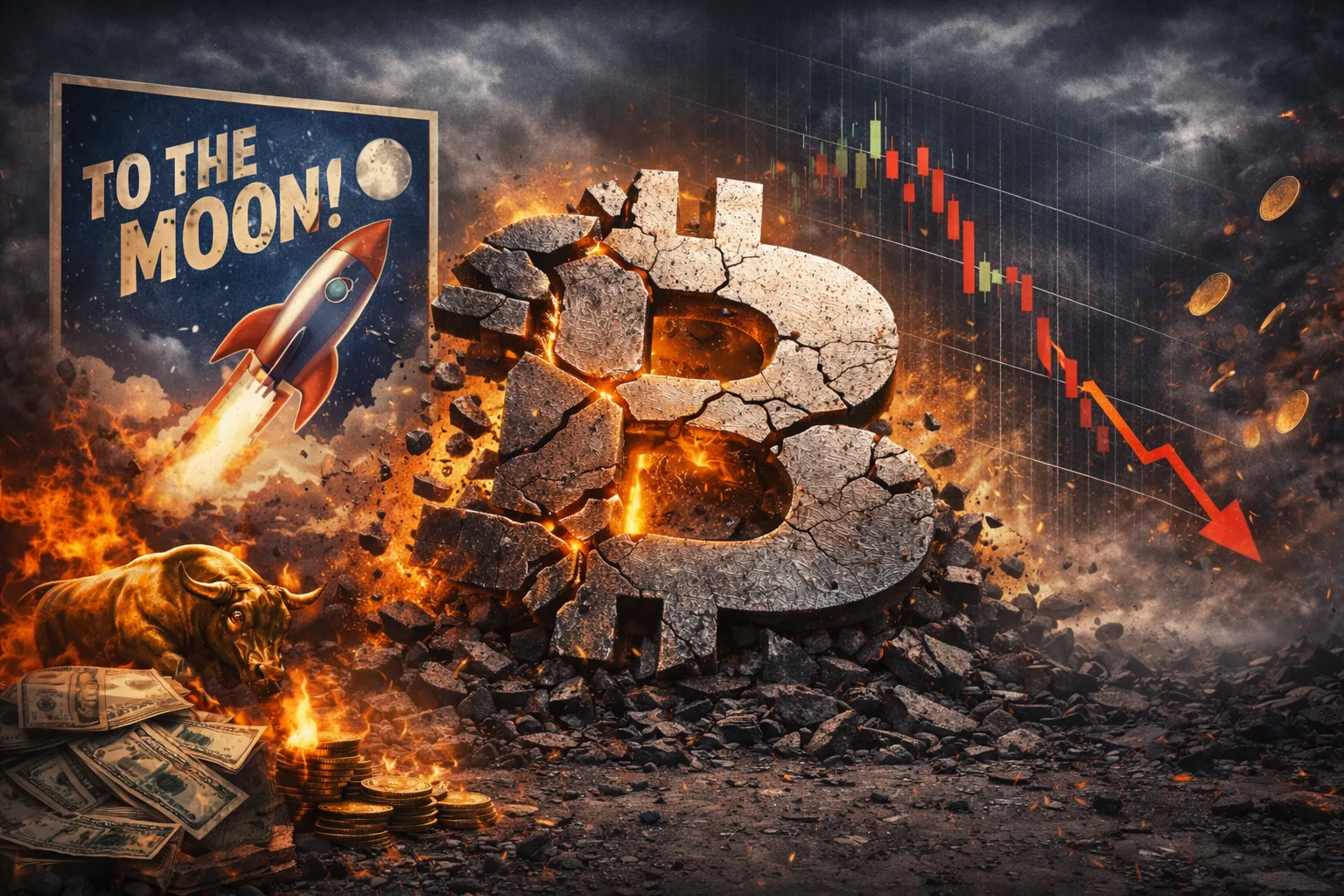
Why Bitcoin Is Crashing Right Now
As of late February 2026, we are seeing this play out in real-time.
After reaching an all-time high of roughly $126,000 in late 2025, Bitcoin has plummeted roughly 50%, currently struggling to hold the $63,000 level.
This creates enormous volatility. Because of Bitcoin’s digital nature, margin calls are instant and automatic.
With large Bitcoin treasuries, such as those held by firms like MicroStrategy (now often referred to simply as Strategy), the risk of extreme collapse becomes very real.
Stablecoins Are Quietly Taking Over
Stablecoins have also taken a significant share of Bitcoin’s market, because they solve many of the same problems while being pegged to the US dollar.
The scale of this shift is massive: in 2025, Stablecoin transaction volume hit roughly $33 trillion, now accounting for around 30% of all on-chain activity.
The Meme Cycle of Bitcoin
Finally, there is clearly a meme element to Bitcoin.
It has been through wave after wave of hype cycles.
First it was internet money for the cool kids. Silk Road, censorship resistance, sticking it to governments.
Then it became digital gold.
Then came the retail mania of 2017.
Then the institutional adoption narrative.
Then the DeFi, NFT, and Web3 boom.
And then the collapse.
When Bitcoin Stops Being Cool
Bitcoin is no longer the thing early adopters want to speculate on.
It’s no longer rebellious, subversive, or even interesting.
It’s a line item in a pension fund.
Momentum Is the Only Thing That Sustains Hype
Hype cycles can only last as long as the momentum is behind them.
They require a constant influx of excitement and new narratives to keep people engaged.
Once the major milestones are reached, what keeps the party going?
The drugs have run out, and people are starting to mong out on the sofa.
Final Thoughts
Bitcoin is falling now because it has been hit by a combination of forces:
- forced selling from margin calls
- capital rotating into Stablecoins
- central banks accumulating gold
- and a lack of new hype to sustain momentum
Bitcoin didn’t escape the system.
It amplified it.
Anyway, that’s just my take.
Those are my two cents on the subject.
What do you think?
Share your thoughts in the comments and let’s discuss. My goal is to keep expanding my understanding.